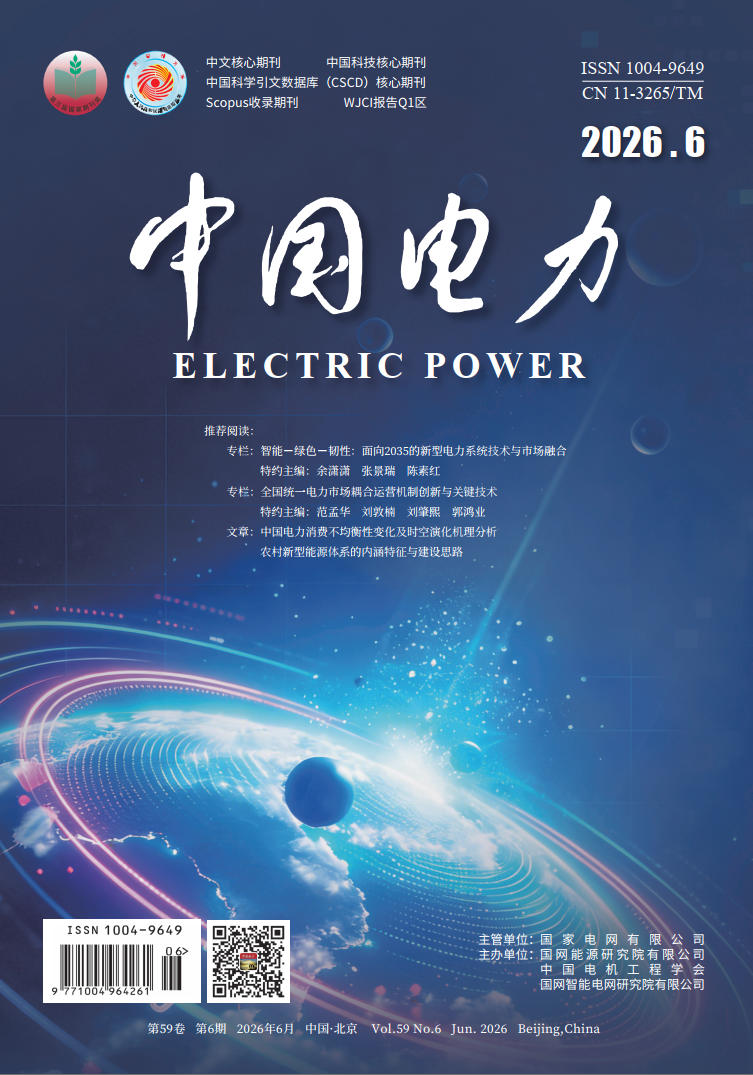
With the continuous increase of the proportion of renewable energy such as wind and solar power in the new power system, the deep integration trend of the energy system and the climate system is becoming more and more significant, and the correlation between the integrated operation of the power system “source, network, load and storage” and the meteor conditions shows the complex characteristics of “full links of power generation, transmission, distribution and consumption, full scale of time and full coverage of region”. However, the current climate change faces many challenges for the development and utilization of renewable energy:the law of spatiotemporal evolution of wind and solar energy resources is still not clear, the transmission and response mechanism climate risks of power system needs to be clarified, and the new power system planning operation lacks the theoretical support of resilience. In this context, it is imperative to systematically reveal the optimized of new energy development under the goal of carbon neutrality, clarify the transmission and response mechanism of climate risks in the new power system, and develop a planning technology system that adapts climate change and enhances the resilience of the system, so as to provide a solid theoretical support and technical guarantee for the construction of the new power system in China
To promote academic exchanges and technological breakthroughs in the cross-field of climate change and power meteorology, the editorial department of China Electric Power has specially Han Xinyang, Director of the Supply and Demand Institute of State Grid Energy Research Institute, Guo Chuangxin, Professor of Zhejiang University, Liu Fei Professor of Sun Yat-sen University, Liu Yunyun, Director of the National Climate Center, Shao Chengcheng, Associate Professor of Xi'an Jotong University, and Cai Bin, Secondary Business Expert of NARI Group to jointly serve as special editors, organizing the column of "Climate Risk Assessment and Meteorological Forecasting and Early Warning Technology for New Power System", and sincerely invite experts and scholars in related fields to actively contribute.
1.Topics of Submission (including but not limited to)
Power meteorological big data and meteorological event backtracking analysis technology
Multi-modal data alignment and structural decomposition method for net load prediction
Analysis and prediction early warning method of the impact of extreme meteorological events (typhoon, icing, drought, etc.) on power
Climate risk assessment and resilience enhancement of power systems
Meteorological vulnerability modeling and fault risk transmission mechanism of power distribution equipment
The Impact of Spatial-Temporal Variation of Wind and Solar Energy Resources on Power Transformation in Various Regions of China
Climate risk assessment indicators and assessment framework for new power systems
Risk assessment system for new power system in China under high-impact weather
Climate risk-informed resilience planning for new power systems
Power weather forecast and early warning
Meteorological fine prediction technology for new power system demand
Prediction and Uncertainty Quantification Methods of New Energy Power
Method for quantifying the uncertainty of water and power supply and output
High-precision load forecasting technology considering meteorological factors
Early warning technology for supply and demand balance of new power system under meteorological impact
2.Special column paper publication plan
Submission deadline: September 2026
Publication time: Starting from the first half of 2026, it will be published in installments as a column
Papers in this column enjoy the preferential treatment of the journal's review green channel. Once accepted, the acceptance notice will be issued as soon as, and priority will be given to online first publication.
3.Submission requirements
Requirements for paper writing. The word count should be around 6000 words, using Word layout, and the format should refer to the paper of "China Electric Power" (be sure to download the latest paper template from the official website of "China Electric Power"); English translations of the title, author, institution abstract, keywords and references need to be provided.
Research on hot and difficult issues in related fields can fully reflect the core innovative achievements of the above professional directions.
Papers should in principle be supported by fund items, please provide the project name and number in a standardized way.
The submitted paper has not been published in any public media.
4.Submission Method
Log in to the website of "China Electric Power": www.electricpower.com.cn, register an author username and password, submit online, and select indicate the "New Power System Climate Risk Assessment and Meteorological Power Forecasting and Early Warning Technology" column.
Contact person
Editorial Department of China Electric Power Zhao Jian
Tel: 010-66603703; Email: zhaojian@sgeri.sgcc.com.
Guest Editor: Han Xinyang, Chief Engineer, Director of the Institute of Economy and Energy Supply and Demand, State Grid Energy Research Institute Co. Ltd.
Email: hanxinyang@sgeri.sgcc.com.cn
Guest Editor: Professor Guo Xinchuang, Zhejiang University
Email: guochuangxin@zju.edu.cn
Guest Editor: Professor Fei Liu, Sun Yat-sen University
Email: liufei26@mail.sysu.edu.cn
Guest Editor: Liu Yunyun, Senior Engineer, Director of Climate Prediction Room, National Climate Center.
Email:liuyuny@cma.gov.cn
Guest Editor: Associate Professor Shao Chengcheng, Xi’an Jiaotong University
Email:ccshao3@xjtu.edu.cn
Guest Editor: Cai Bin, Senior Engineer, South China Grid Group, Second-level Business Expert
Email:caibin@sgepri.sgcc.com.cn
5.Introduction of the guest editor
Han Xinyang, Director of the Institute of Economics and Energy Supply and Demand of State Grid Energy Research Institute Co., Ltd.,, Senior Engineer. He has been engaged in research work in the fields of new power system, power grid development, energy and power supply and demand analysis, power economy, power grid, demand response, meteorological power, etc. for a long time. The relevant achievements provide reference for the compilation of policy documents by government departments and the power industry, and formulation of operation strategies by power enterprises. He has presided over more than 30 provincial-ministerial, industry-level, and company-level projects. He has in the compilation of 7 academic monographs such as "Integrated Resource Strategy Planning and Power Demand Side Management", and more than 10 annual reports such as "China Supply and Demand Analysis Report" and "China Energy Conservation and Power Saving Analysis Report". He has published more than 30 academic papers. He has won more than 0 awards, including the National Energy Science and Technology Progress Award, the National Energy Administration Soft Science Research Outstanding Achievement Award, the China Electric Power Science and Technology Award, the Grid Corporation of China Science and Technology Progress Award, and the State Grid Corporation of China Soft Science Outstanding Achievement Award.
Guo Xinchuang, an outstanding professor of Zhejiang University, a doctoral supervisor, a fellow of the Chinese Society for Engineering, the deputy director of the State Grid-Zhejiang University Smart Power Energy Research Institute, and the director of the Energy Internet Research Center of Zhejiang University. serves as a member of the CIGRE China National Committee, the deputy chairman of the National Energy Internet Industry and Technology Innovation Alliance, and the deputy director of the Power System Autom Professional Committee of the Chinese Society for Electrical Engineering, the deputy director of the Power System Control and Protection Professional Committee of the Chinese Society of Electrical Engineering, the deputy director of the Youth Education Work Committee of the Chinese Society for Electrical Engineering, the deputy director of the New Energy Intelligent Manufacturing and Application Technology Professional Committee of the Chinese Energy Research Society, and the director of the Source Network Load Storage Coordinated Operation and Control Technology Professional Committee of the Chinese Energy Research Society. He was selected into the "New Century Excellent Talent Support Plan" by Ministry of Education, the first level/key talent of the Zhejiang Province New Century 151 Talent, and the recipient of the Zhejiang Province Outstanding Youth. He won the China Electric Power Science and Technology Figure Award and the Zhejiang Electric Power Science and Technology Figure Award. He has published more than 390 academic papers obtained 135 authorized invention patents. As the person in charge, he has hosted more than 70 scientific research projects, including 2 national key projects of the National Science Foundation, and won 4 first prizes and 4 second prizes at the provincial and ministerial levels.

Liu Fei, a professor at the School of Atmospheric Sciences of Sun Yat-sen University, director of the Laboratory of Climate Change Clean Energy, doctoral supervisor, and a special-appointed professor in Jiangsu Province. He is a member of the Dynamic Committee of the Chinese Meteorological Society, a author of the Sixth IPCC Report, and a member of the WMO SAGE (sub-seasonal-2-seasonal prediction for agriculture & environment)- working group. His main research directions include the assessment and prediction of new energy resources. He has been exploring the formation and origin mechanisms of the inter-seasonal variability of the mon system to provide a theoretical basis for improving the monsoon's sub-seasonal prediction skills, exploring the optimal application theory of predicting catastrophic weather and climate events, and developing-quality prediction systems for new energy. He has published more than 100 SCI papers including BAMS (Highlight paper of the flagship journal of meteorology), Communications, Journal of the Atmospheric Sciences, Science Advance, Nature Climate Change, etc. He is also an Associate Editor of Journal of Climate and a member of the editorial board "China Electric Power".

Liu Yunyun, a doctor of meteorology, currently serves as the director of the Climate Prediction Room at the National Climate Center, senior engineer, a chief meteorological expert in the High-level Science and Technology Innovation Talent Plan of the China Meteorological Administration, and the leader of the "Energy Climate Service Team". She has been engaged in scientific research and application work in climate anomaly diagnosis and short-term climate prediction for a long time, and has achieved systematic and innovative results in predictability, the causes of extreme weather and climate events, and climate prediction technology. She has hosted more than 10 scientific research projects including the National Natural Science Foundation, National Key Research and Development Program, and meteorological industry standards; as the first (corresponding) author, she has published more than 40 papers in multiple high-quality SC journals (Nature Climate Change, Geophysical Research Letters, Environment Research Letters, Advances in Atmospheric Science, etc.); as the first author, she has published the monograph "The Asian Summer Monsoon" published by Elsevier.

Shao Chengcheng, School of Electrical Engineering, Xi'an Jiaotong University, Associate Professor, Ph.D. Supervisor He has been engaged in the research of power energy system planning and power load dispatching for a long time. In recent years, he has presided over several projects/topics as the National Key Research and Development Program, the National Natural Science Foundation, etc. He is a member of the editorial board of IEEE Trans. Transportation Electrification, a editor of "China Electric Power" and "Electric Power Automation Equipment", the secretary general of the IEEE PES Xi'an Chapter, and a member of the National Power Demand Side Management Standardization Technical Committee (SAC/TC 575). He has won awards such as the First Prize of the National Natural Science Award, the Prize of the Ministry of Education Natural Science Award, the Second Prize of the Shaanxi Province Science and Technology Award, the Outstanding Doctoral Thesis of Xi'an Jotong University, and the Best Paper Award of the IEEE PES General Meeting.
Cai Bin, PhD, Senior Professional Engineer, Supervisor of Doctoral Students (Industry), and one of the first batch of talents for the State Grid Youth Talent Support Program, is currently a Level-II Business Expert at the State Grid Electric Power Research Institute (NARI Group) Co., Ltd. He been engaged in the fundamental research and strategic consulting services related to the "Double Carbon" goals and energy transition strategy for a long time. He has won the First Prize of the State Corporation of China Science and Technology Progress Award (ranked 2nd), the Second Prize of the State Grid Corporation of China Patent Award (ranked 4th), and the Top Ten Scientific and Technological Progresses in the Field of Environment and Energy in Jiangsu Province in 2024 (ranked 2nd). He is a member the China Youth Science and Technology Workers Association, a member of the Jiangsu Youth Federation, a member of the Youth Scientists Special Committee of the 10th Standing Committee the Jiangsu Science and Technology Association, a director of the Jiangsu Youth Science and Technology Workers Association, and a specially invited teaching expert for the National Postgraduate Supervisor Program of the Ministry of Education. He has won the Jiangsu Provincial Electric Power Outstanding Young Engineer Award and has been awarded the titles of Jiangsu Youth Double Talent and Jiangsu Province Youth Post Expert.